
Slater Memorial Art Museum: The Most Special Art Museum in the World
Only two high schools in the US have a museum on campus
On the high school campus of Norwich Free Academy in Norwich, Connecticut, there is an art museum that has done something quietly radical for well over a century: it has placed world cultures, art history, and original objects in front of students early enough that they grow up believing art belongs in their everyday lives. That museum is Slater Memorial Museum.
For the founder of Museo, this was never just a museum. It was a formative environment — a place that helped build an internal architecture of attention, curiosity, and reverence. The many years she spent in the peaceful sanctuary that is Slater undoubtedly influenced her passion for the arts, eventually leading to the creation of Museo, a global tool that brings art to people in much the same way this extraordinary museum did for her.
A museum gifted to a school — and to a city
Slater Memorial Museum traces its beginnings to a remarkable act of philanthropy in the late nineteenth century. In 1884, Norwich Free Academy graduate William Albert Slater made a substantial gift to the school to fund the creation of a dedicated art building in honor of his father, John Fox Slater. Construction began the following year, the building was formally dedicated in November of 1886, and it welcomed the public soon after, opening its doors in 1888.
From the start, the museum was envisioned as part of an educational environment rather than separate from one. It was not designed as a distant cultural destination students might encounter later in life, but as a space they would pass through regularly — a place where art and learning would grow up side by side.
The building is part of the collection
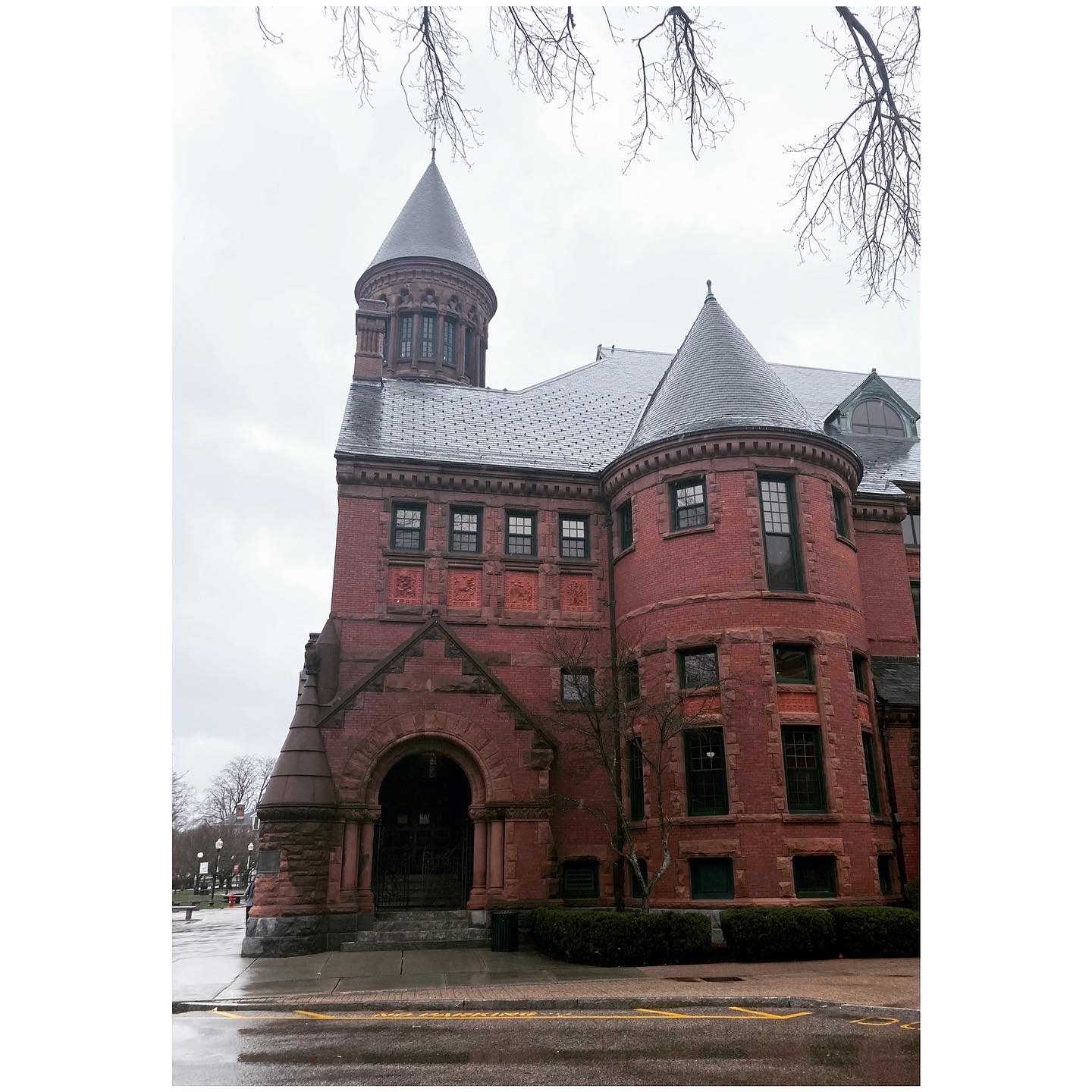
The building itself is an important part of Slater’s story. It was designed by Worcester architect Stephen C. Earle, who worked in the Romanesque Revival tradition — a style known for its weight, texture, and sense of historic gravitas. The museum is often cited as one of the most significant works of Earle’s career, a structure where architecture and purpose feel inseparable.
That Romanesque influence can be felt as much as seen. Rounded arches, substantial stonework, and medieval-inspired design elements give the building a sense of durability and quiet authority. Inside, the craftsmanship continues in details like stained glass, patterned marble floors, decorative brickwork, and carved wooden moldings fashioned from oak, chestnut, and cherry. These elements create an atmosphere that feels both grounded and ceremonial at once.
The building’s importance extends beyond aesthetics. It is recognized as a contributing structure within Norwich’s Chelsea Parade Historic District, which is listed on the National Register of Historic Places. In other words, the museum is not simply a place where art is displayed — it is itself part of the region’s cultural and architectural heritage.
This is why visitors often feel that Slater is more than just a gallery space. The building shapes the experience from the moment you enter, preparing you to look more closely, move more slowly, and understand that what lives inside is meant to be encountered with care.
Emily’s first museum memories started at the door
Starting in kindergarten, Emily went on field trips to Slater Memorial Museum several times a year — continuing until she was a student at Norwich Free Academy herself. Over time, the museum became familiar in the way sacred places become familiar: not smaller, but more layered.
Emily still remembers what it felt like to enter through gothic-feeling archways and ornate, heavy wooden doors — and, in her memory, to be greeted by an Egyptian figure of Amenhotep III before climbing stairways that felt almost Hogwarts-like, carrying children into something vast and old. That early sensory imprint — the threshold, the hush, the upward climb — is part of the museum’s power. Even without knowing terms like “Romanesque Revival,” young visitors feel they are walking into history.
Just a few miles from her childhood home, this museum stood like a secret too big to keep — a world-class collection living quietly inside a school campus, available not just once, but again and again.
A “treasure trove” spanning five continents
For well over a century, Slater Memorial Museum has introduced visitors to art and material culture from across the globe. Its holdings span continents and eras, offering students and the public opportunities to encounter artistic traditions far beyond their own immediate surroundings.
The permanent collection is notably diverse. It includes American and European paintings and decorative arts, sculptural works from African and Oceanic cultures, objects representing Native American artistry, and an extensive group of historical plaster casts drawn from ancient Egyptian, Greek, Roman, and Renaissance sources. Together, these works create a visual timeline that connects civilizations, styles, and ideas across centuries.
Slater also offers visitors the rare opportunity to stand face-to-face with faithful full-scale casts of some of the most celebrated sculptures in Western art history — works like the Nike of Samothrace, Michelangelo’s Pietà, and figures from the west pediment of the Temple of Zeus at Olympia. While the original marbles live in distant museums across the world, these carefully produced casts bring their scale, drama, and physical presence within reach of a hometown audience.
The museum’s collection is also deeply rooted in its own community. Slater holds an especially strong group of nineteenth-century American works connected to Norwich, including significant representation of local artists such as John Denison Crocker and Alexander Hamilton Emmons, whose paintings reflect regional landscape and portrait traditions. Through this balance of global breadth and local depth, the museum quietly teaches an essential lesson: art history is both worldwide and close to home. Masterpieces don’t only happen elsewhere — they happen here, too. One of Emily’s favorite Norwich-inspired works in the collection is a painting of Yantic Falls by artist John Trumbull — a place she passed each day on her way to school at NFA and still visits whenever she returns home.
How a student learns differently when the objects are real
As a high school student in Norwich Free Academy’s fine arts program, Emily spent her days practicing drawing skills using the museum’s sculptures as subjects. Drawing from sculpture teaches discipline: measuring angles, capturing proportion, translating form into shadow, building patience into the hand. It also teaches something more subtle — that attention is an act of respect. The museum becomes a studio, and history becomes tactile. A student can’t unlearn that.
For many students, museums are places visited once, maybe twice, with a docent voice floating above them like weather. Slater’s place within Norwich Public Schools' curriculum is something quite different. It’s a museum revisited, and a regular part of a student’s arts and history education. It becomes part of the landscape of growing up.
Honoring Slater's Caretakers
From Kindergarten all the way through NFA graduation, the director of Slater Memorial Museum was Mrs. Mary-Anne Hall, remembered by Emily as a woman who treated every artifact as if it were genuine treasure — cared for individually, protected carefully, and interpreted with seriousness. Slater is the kind of institute that depends on this sort of long devotion: the daily, unglamorous work of preservation, organization, and stewardship that makes a museum feel coherent and alive. Emily still has a vintage necklace and earrings set Mrs. Hall gifted to her at graduation, something Emily categorizes as “art teacher jewelry.” This gift was foreshadowing, for Emily graduated from Massachusetts College of Art & Design with a degree in Community Art Education.
Today, Slater’s steward is Mr. Dayne Rugh, whose contributions through the museum’s Curator’s Corner reflect a forward-looking vision. His work includes developing exhibitions connected to the America 250 initiative and finding fresh ways to share stories from the permanent collection with the public. He also launched the museum’s first alumni art sale program through the Slater gift shop, creating a space for Norwich Free Academy graduates to showcase and sell their work while strengthening ties within the community.
In 2022, Emily had the honor of meeting Mr. Rugh — and was given a gift she never imagined would come true. He gave her a tour of the legendary Slater tower, a place wrapped in stories, myths, and school-day lore. As a senior at NFA, she reached the tower door only once, before being caught by Mrs. Hall and firmly sent back to class. This time, she finally stepped inside the tower door marked with decades of etchings carved by past students who were successful in reaching it without getting caught.
Why this museum lives inside Museo
Museo is grounded in a simple belief: art should be appreciated and accessible to all, just as Slater has made art part of everyday life for its community.
As a means of somehow finding a way of repaying the Slater Memorial Museum legacy of educators and influence, and its impacts on our founder’s artistic development, Museo has granted Slater a forever curator account, ensuring that the museum’s director and future staff can continue sharing what Slater holds with Museo’s userbase for years to come. In a sense, it is a digital continuation of Slater’s original mission: making art accessible, not only to scholars and tourists, but to students, families, locals, and everyday explorers.
Slater influenced the inventor of Museo not through a single life-changing visit, but through repetition — through years of returning to the same doors, the same stairways, the same steady invitation to look closer. It taught her that art history is not abstract. It is held in objects. It is held in architecture. It is held in the care of people who show up every day to keep a collection alive.
And sometimes, it is held in a child who grows up inside a museum — and later builds something that helps the rest of the world find art, too.
-The Museo Docent
1
42